Inverse of a Matrix
using Elementary Row Operations
Also called the Gauss-Jordan method
This is a fun way to find the Inverse of a Matrix:
![Augmented matrix transformation from [A | I] to [I | A⁻¹]](images/matrix-gauss-jordan1.svg)
The "Elementary Row Operations" are simple things like adding rows, multiplying and swapping ... let's see with an example:
Warm Up: A 2×2 Example
Let's see how it works on a small 2×2 matrix first:
First we join matrix A and the Identity Matrix side-by-side. This combined grid is called an augmented matrix [A | I]:
Now we try to make the left side the Identity Matrix.
- Choose any row operations you want!
- Keep both sides in sync (apply any row operation to the whole row, left and right sides)
- Here is one way to do it:
Subtract 3 × Row 1 from Row 2:
Divide Row 2 by −2:
Subtract 2 × Row 2 from Row 1:
The left side is now the Identity Matrix ... and the right side now has our inverse:
Bigger Example: find the Inverse of "A":
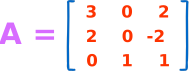
We start with the matrix A, and write it down with an Identity Matrix I next to it:
![Augmented matrix [A | I] with 3 by 3 matrix A and 3 by 3 identity matrix](images/matrix-gauss-jordan6.gif)
(This is called the "Augmented Matrix")
Identity Matrix
The "Identity Matrix" is the matrix equivalent of the number "1":
A 3x3 Identity Matrix
- It is "square" (has same number of rows as columns),
- It has 1s on the diagonal and 0s everywhere else
- Its symbol is the capital letter I
Now we do our best to turn "A" (the Matrix on the left) into an Identity Matrix. The goal is to make Matrix A have 1s on the diagonal and 0s elsewhere (an Identity Matrix) ... and the right hand side comes along for the ride, with every operation being done on it as well.
But we can only do these "Elementary Row Operations":
- swap two rows
- multiply (or divide) every element in a row by a non-zero constant
- replace a row by adding or subtracting a multiple of another row
And we must do it to the whole row, like in this example:
![Six-step Gauss-Jordan row reduction on augmented matrix [A | I]](images/matrix-gauss-jordan2.svg)
Start with A next to I
Let's add row 2 to row 1,
Then divide row 1 by 5
Then take 2 times the first row, and subtract it from the second row,
Multiply second row by -1/2,
Swap the second and third row,
Last, subtract the third row from the second row,
And we are done!
And matrix A has been made into an Identity Matrix ...
... and at the same time an Identity Matrix got made into A-1
DONE! Like magic, and just as fun as solving any puzzle.
(Compare this to Inverse of a Matrix using Minors, Cofactors and Adjugate. Is the answer the same? Which method do you prefer?)
A Systematic Way
There's no "right way" to do this!
We can just keep playing around until we get that final correct answer.
But it can be helpful to follow a plan:
- First aim for a 1 in the top-left corner
- Then try for 0s in the rest of that column
- Then aim for a 1 in the next diagonal element, and 0s elsewhere in that column
- Repeat until you have the Identity Matrix!
Larger Matrices
We can do this with larger matrices, for example, try this 4x4 matrix:
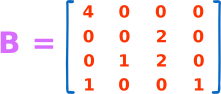
Start Like this:
![Augmented 4 by 4 matrix [B | I]](images/matrix-gauss-jordan9.gif)
See if you can do it yourself (I would begin by dividing the first row by 4, but you do it your way).
You can check your answer using the Matrix Calculator (use the "inv(A)" button).
Why it Works
![Analogy showing [8 | 1] transformed by row operation into [1 | 1/8]](images/matrix-gauss-jordan5.svg)
I like to think of it this way:
- when we turn "8" into "1" by dividing by 8,
- and do the same thing to "1", it turns into "1/8"
And "1/8" is the (multiplicative) inverse of 8
Or, more technically:
![Multiplication of [A | I] by A⁻¹ yielding [I | A⁻¹]](images/matrix-gauss-jordan7.svg)
The total effect of all the row operations is the same as multiplying by A-1
So A becomes I (because A-1A = I)
And I becomes A-1 (because A-1I = A-1)
What if it Doesn't Work?
We can end up with a row of all zeros on the left-hand side (the A side).
That means we can't turn it into the Identity Matrix, as the matrix is Singular and has no inverse! Yes, it can happen.