Linear Equations
A linear equation is an equation for a straight line
These are all linear equations:
 |
y = 2x + 1 | |
|
5x = 6 + 3y | |
|
y/2 = 3 − x |
Let us look more closely at one example:
Example: y = 2x + 1 is a linear equation:
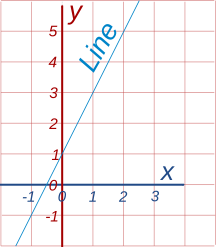
The graph of y = 2x+1 is a straight line
- When x increases, y increases twice as fast, so we need 2x
- When x is 0, y is already 1. So +1 is also needed
- And so: y = 2x + 1
Here are some example values:
| x | y = 2x + 1 |
|---|---|
| -1 | y = 2 × (-1) + 1 = -1 |
| 0 | y = 2 × 0 + 1 = 1 |
| 1 | y = 2 × 1 + 1 = 3 |
| 2 | y = 2 × 2 + 1 = 5 |
Check for yourself that those points are part of the line above!
Different Forms
There are many ways of writing linear equations, but the key idea is:
- Variables are only to the first power (x, y, and so on),
- Variables are not multiplied together (no xy),
- No variables in denominators (no 1x and so on)
Examples: These are linear equations:
|
y = 3x − 6 | |
|
y − 2 = 3(x + 1) | |
|
y + 2x − 2 = 0 | |
|
5x = 6 | |
|
y/2 = 3 |
But the variables (like "x" or "y") in Linear Equations do NOT have:
- Exponents (like the 2 in x2)
- Square roots, cube roots, and so on
Examples: These are NOT linear equations:
 |
y2 − 2 = 0 | |
|
3√x − y = 6 | |
|
x3/2 = 16 | |
|
xy = 1 |
Slope-Intercept Form
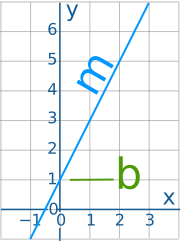
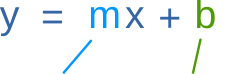
The most common form is the slope-intercept equation of a straight line:
 |
|
| Slope (or Gradient) | Y Intercept |
Example: y = 2x + 1
- Slope: m = 2
- Intercept: b = 1
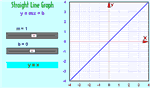 |
Play With It !You can see the effect of different values of m and b at Explore the Straight Line Graph |
Point-Slope Form
Another common one is the Point-Slope Form of the equation of a straight line:
y − y1 = m(x − x1)
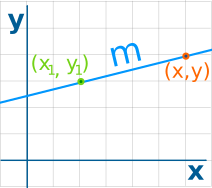
Example: y − 3 = (¼)(x − 2)
It is in the form y − y1 = m(x − x1) where:
- y1 = 3
- m = ¼
- x1 = 2
General Form
And there is also the General Form of the equation of a straight line:
|
Ax + By + C = 0 |
| (A and B cannot both be 0) |
Example: 3x + 2y − 4 = 0
It is in the form Ax + By + C = 0 where:
- A = 3
- B = 2
- C = −4
There are other, less common forms as well.
As a Function
Sometimes a linear equation is written as a function, with f(x) instead of y:
| y = 2x − 3 |
| f(x) = 2x − 3 |
| These are the same! |
And functions are not always written using f(x):
| y = 2x − 3 |
| w(u) = 2u − 3 |
| h(z) = 2z − 3 |
| These are also the same! |
The Identity Function
There is a special linear function called the "Identity Function":
f(x) = x
And here is its graph:
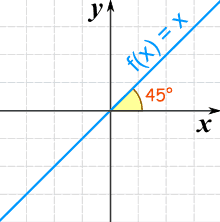
It makes a 45° (its slope is 1)
It is called "Identity" because what comes out is identical to what goes in:
| In | Out |
|---|---|
| 0 | 0 |
| 5 | 5 |
| −2 | −2 |
| ...and so on | ...and so on |
Constant Functions
Another special type of linear function is the Constant Function ... it is a horizontal line:
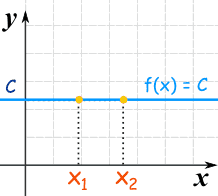
f(x) = C
No matter what value of "x", f(x) is always equal to some constant value.
Using Linear Equations
You may like to read some of the things you can do with lines: