Cubes and Cube Roots
Before exploring cube roots, let's first see how to cube a number...
How to Cube A Number
To cube a number: use it in a multiplication 3 times ...
Example: What's 3 cubed?
| 3 cubed | = | 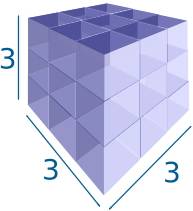 |
|
| = | 3 × 3 × 3 | = 27 |
Note: we write "3 cubed" as 33
(the little 3 means the number appears three times in multiplying)
Cubes From 03 to 53
Cube Root
A cube root reverses the process: it finds what we multiply to get the cubed value:
3 cubed is 27, so the cube root of 27 is 3
| 3 | 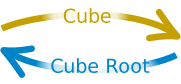 |
27 |
The cube root of a number is ...
... a value that when cubed gives the original number.
The cube root of 27 is ...
... 3, because when 3 is cubed we get 27.
 |
Note: When you see "root" think "I know the tree, but what root made it?" In this case the tree is "27", and the cube root is "3". |
Here are some cubes and cube roots:
|
||
|
1 |
1 |
|
|
2 |
8 |
|
|
3 |
27 |
|
|
4 |
64 |
|
|
5 |
125 |
|
|
6 |
216 |
|
|
... |
... |
|
Example: What's the cube root of 125?
Well, we just happen to know that 125 = 5 × 5 × 5 (if we use 5 three times in a multiplication we get 125) ...
... so the cube root of 125 is 5
The Cube Root Symbol
 |
This is the special symbol that means "cube root", it is the "radical" symbol (used for square roots) with a little three to mean cube root. |
We can use it like this:
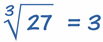
we say "the cube root of 27 equals 3"
We Can Also Cube Negative Numbers
Have a look at this:
So the cube root of −125 is −5
Perfect Cubes
The perfect cubes are the cubes of the whole numbers:
| Perfect Cubes |
|
| 0 | 0 |
| 1 | 1 |
| 2 | 8 |
| 3 | 27 |
| 4 | 64 |
| 5 | 125 |
| 6 | 216 |
| 7 | 343 |
| 8 | 512 |
| 9 | 729 |
| 10 | 1000 |
| 11 | 1331 |
| 12 | 1728 |
| 13 | 2197 |
| 14 | 2744 |
| 15 | 3375 |
| and so on... |
It is easy to work out the cube root of a perfect cube, but it is really hard to work out other cube roots.
Example: what's the cube root of 30?
Well, 3 × 3 × 3 = 27 and 4 × 4 × 4 = 64, so we can guess the answer is between 3 and 4.
- Let's try 3.5: 3.5 × 3.5 × 3.5 = 42.875
- Let's try 3.2: 3.2 × 3.2 × 3.2 = 32.768
- Let's try 3.1: 3.1 × 3.1 × 3.1 = 29.791
We are getting closer, but very slowly ... at this point, I get out my calculator and it says:
3.1072325059538588668776624275224...
... but the digits just go on and on, without any pattern. So even the calculator's answer is only an approximation !
Since the decimals go on forever, we usually round our answer:
The cube root of 30 = 3.107 (rounded to 3 decimal places).
(Further reading: these kind of numbers are called surds which are a special type of irrational number)