Using and Handling Data
Data is a collection of facts and numbers. Probability tells us how likely something is to happen. Statistics is like detective work to find patterns and solve number mysteries.

What's Data?
How to Show Data
- Bar Graphs
- Pie Charts
- Dot Plots
- Line Graphs
- Histograms
- Make a Bar, Line, Dot or Pie Graph
- Pictographs
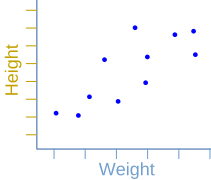
- Scatter (x,y) Plots
- Frequency Distribution and Grouped Frequency Distribution
- Stem and Leaf Plots
- Cumulative Tables and Graphs
- Data - Thinking Clearly
- Making Sense of Data
- Misleading Graphs and Stats
- Graph Paper Maker
Surveys


Probability and Statistics
Measures of Central Value
- Finding a Central Value
- Calculate the Mean Value and The Mean Machine
- Find the Median Value
- Find the Mode or Modal Value
Advanced:
- Calculate the Mean from a Frequency Table
- Weighted Mean
- Geometric Mean
- Harmonic Mean
- Transforming Data
- More Advanced:Mean, Median and Mode from Grouped Frequencies
Measures of Spread
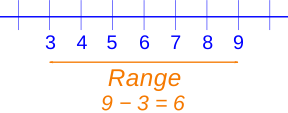
- The Range
- Quartiles and the Interquartile Range
- Percentiles
- Mean Deviation
- Standard Deviation
- Standard Deviation Calculator
- Standard Deviation Formulas
Comparing Data
Probability
Activities:
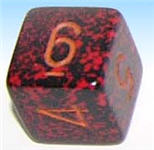
- An Experiment with a Die
- An Experiment with Dice
- Dropping a Coin onto a Grid
- Buffon's Needle
- Random Words
- Lotteries
Events
- Complement
- Probability: Types of Events
- Independent Events
- Dependent Events: Conditional Probability
- Tree Diagrams
- Compound Events
- Mutually Exclusive Events
Combinations and Permutations
Data Fitting
Testing
- False Positives and False Negatives
- Bayes Theorem
- Confidence Intervals and Confidence Interval Calculator
- Chi-Square Test and Chi-Square Calculator
- Degrees of Freedom
- Student's T-Test and T-Test Table
Other
Random Variables
- Random Variables
- Random Variables - Continuous
- Random Variables - Mean, Variance and Standard Deviation
The Binomial Distribution
The Normal Distribution