Game Theory: Sequential Games

In Sequential Games, players take turns making decisions. Each player can see what has already happened before choosing their next move.
This is different from games where everyone moves at the same time. Here, order matters!
What Makes a Game Sequential?
- Players move one after another
- Later players can see earlier choices
- Each choice can affect future options
Many real-life situations work this way: board games, sports strategies, and even deciding who gets the last slice of pizza!
A Simple Example
Example: Choosing a Treat
Player A chooses first:
- Take the big cookie, or
- Take the small cookie
Then Player B takes what is left.
Because Player A knows Player B's choice comes next, Player A must think ahead: "What will happen after my choice?"
Game Trees
Sequential games are often shown using a game tree.
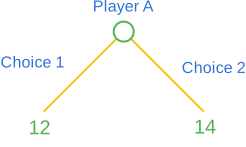
Each branch shows a possible move, and each endpoint shows the final outcome.
- Circles (nodes) represent decision points
- Branches represent choices
- Ends of branches show results (payoffs)
Thinking Ahead (Backward Induction)
To solve many sequential games, we use backward induction.
That means:
- Start at the end of the game
- Figure out the best choice there
- Work backwards to the start

Each player assumes the other players will make smart choices when their turn comes.
See 5 Pirates Puzzle
Example: Backward Thinking
Example: Splitting the Coins
Imagine Alex can decide what to do with 10 coins. Choices are:
- Give Sam 1 coin and keep 9 coins for themselves
- Split the coins evenly, 5 each
After that, Sam can either accept the offer or reject it. If Sam rejects, neither player gets anything.
To figure out the smartest move, we can think backwards:
- Sam would rather get 1 coin than nothing, so will accept either offer
- Knowing this, Alex can safely choose the option that gives them the most coins
So in this game, Alex can keep 9 coins, and Sam will accept only 1. Even though the game seems unfair, thinking ahead shows why this choice will work!
(Alex likes Sam and just shares equally anyway.)
Sequential vs Simultaneous Games
| Sequential Games | Simultaneous Games |
|---|---|
| Players move one after another | Players move at the same time |
| Earlier moves are visible | Moves are hidden |
| Often solved by backward induction | Often solved using Nash Equilibrium |
Why Sequential Games Matter
Sequential games help us understand:
- Negotiations and bargaining
- Pricing and business strategy
- Planning ahead in competitive situations
- Why going first can be an advantage (or sometimes a disadvantage!)
Summary
- Sequential games involve players taking turns
- Later players can see earlier choices
- Game trees help show all possibilities
- Backward induction helps find the best strategy
Once we start thinking ahead, sequential games become a powerful way to understand real-world decisions.