Estimation Tips and Tricks
Estimation is finding a number that's close enough to the exact answer.
- We are not trying to get the exact right answer
- What we want is something that's good enough (usually in a hurry!)

Example: you want to buy eight magazines that cost $1.95 each. When you go to buy them the cost is $17.25. Is that right?
"eight lots of $1.95 is about 8 times 2, or about $16"
so $17.25 seems too much!
Ask to have the total checked.
Estimation helps with your Confidence, Judgement and Decisions!
How to Estimate
Before doing the actual calculation we should think:
"how do I go about making this estimate?"
Because different numbers need different methods:
Example:
- 550 + 298: 298 is nearly 300 so an estimate is 550+300 = 850
- 550 + 248: 50+48 is nearly 100 so an estimate is 500+200 +100 = 800
In one case it seemed easy to change one number and then add.
In the other it seemed better to add the hundreds and then increased the result by 100
There's no "right way".
Whatever works for you is fine!
But how do you know what to do? Lots of Practice!
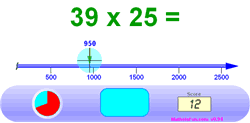
So we have Estimation Games for you to practice with.
Together with the following Tips and Tricks, you will become a Master at Estimation.
Tips and Tricks
Here are a few methods you might like to use:
Then look at the other digits to make smaller adjustments to your answer.
Example: 2156 + 3809
Add 2000 and 3000 to get 5000. Then look at the rest of the numbers: "156 plus 809 is nearly a thousand", so increase your answer to 6000.
That also works with decimal numbers:
Example: what's 12.48 + 3.96?
Round to easy numbers first:
12.48 ≈ 12.5 and 3.96 ≈ 4
Then add:
12.5 + 4 = 16.5
So 12.48 + 3.96 is about 16.5.
Example: what's 18.02 − 9.78?
Round to easy numbers:
18.02 ≈ 18 and 9.78 ≈ 10
Then subtract:
18 − 10 = 8
So 18.02 − 9.78 is about 8.
Example: what's 0.3126 times 53.81?
Multiply 0.3 × 50 to get 15.
And because we rounded both numbers down we know our estimate is a bit low. So let's adjust it higher to 17.
Round the numbers up or down before the calculation.
Example: 206 × 390
Because 206 is nearly 200, and 390 is nearly 400, the answer will be close to
200 × 400 = 80,000
In the previous example we calculated 200 × 400 = 80,000. How do we know how many zeros?
Well, after multiplying 2×4 to get 8, there are the two zeros from 200 plus the two zeros from 400, making four zeros after the 8: 80,000
Example: What's 345 + 380 + 310 + 375 + 330 + 362?
There are 6 numbers, all around 350:
6 × 350 = 2100
Example: what's 176 divided by 3?
Change 176 to 180 (because 3×6=18) and then do:
180 / 3 = 60
then adjust a little lower to 59
Example: what's 76 + 49 + 22 + 53?
76 and 22 are nearly 100.
And 49 and 53 are also about 100.
So the answer must be about 200
Example: what's 52 × 13 × 20
The two outer number, 52 and 20 multiply to be about 1000 (5×2=10),
THEN multiply by 13 to get 13,000
Example: 1.6 × 30
1.6 is close to 1.5, which is 1 and a half.
So 1.6 × 30 is close to 30 plus half of 30, which is 30 + 15 = 45.
Adjust a little higher for an estimate of 47
Example: 0.108 × 50
0.108 is close to one-tenth, so 0.108 × 50 is close to one-tenth of 50 or about 5
Adjust a little higher for an estimate of 5.5
Example: what's 20% of $15?
20% is 0.2, or two-tenths.
One tenth of $15 is $1.50, so two tenths is $3.00
Example: what's 9/10 plus 7/8?
Both 9/10 and 7/8 are close to 1, so the answer is close to 2 but a bit less.
Example: what's 4/9 times 12?
4/9 is nearly half so the answer must be close to half of 12, or about 6.
Estimating Counts, Lengths and More
Estimation isn't always about doing calculations! It is important for you to be able to estimate how many things you can see, or how long something is, or how big something is.
See our page on Visual Estimation