How Division Works
Division is breaking a big group into smaller, equal parts.
We can do it with Fair Sharing or Repeated Subtraction.
Fair Sharing
Fair Sharing is useful when we know how many groups we want, but we don't know how many items go in each group.
Example: We have 12 chocolates and 3 friends. How many chocolates does each friend get?
The Action: "One for you, one for you, one for you..." until they are all gone.
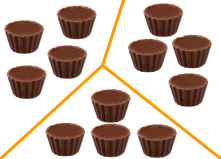
Result: 12 divided into 3 equal groups gives 4 in each group.
Repeated Subtraction
Repeated Subtraction is useful when we know how many are in each group, and we want to discover how many groups we can make.
Example: We have 12 chocolates. We give 4 chocolates to each person. How many people get chocolates?
We subtracted 4 a total of 3 times. So, 12 ÷ 4 = 3 people.
Which way is better?
Both ways are correct! Just a different use for each.
Fair Sharing: 12 items shared between 3 groups gives 4 in each group
12 ÷ 3 = 4
Repeated Subtraction: 12 items in groups of 4 makes 3 groups
12 ÷ 4 = 3
Fact Family
The numbers 3, 4, and 12 belong to the same fact family. Division and multiplication are closely connected.
- 3 × 4 = 12
- 4 × 3 = 12
- 12 ÷ 4 = 3
- 12 ÷ 3 = 4
Remainder
Division doesn't always end up perfectly, there can be something left at the end. We call that the Remainder.
Example: We have 14 chocolates. We give 4 chocolates to each person. How many people get chocolates?
We subtracted 4 a total of 3 times. But there are 2 left over (remainder).
We write this as:
14 ÷ 4 = 3 R 2