Exterior Angle Theorem

The exterior angle is the angle between a side and a line extended from the next side.
The two angles on the inside that are opposite the exterior angle are called remote interior angles.
The Exterior Angle Theorem says:
A triangle's exterior angle d:
- equals the angles a plus b
and
- is greater than angle a
- is greater than angle b
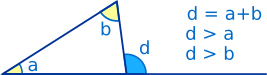
Example:
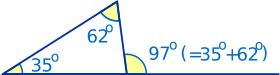
The exterior angle is 35° + 62° = 97°
And 97° > 35°
And 97° > 62°
Why Is This True?
Because the interior angles of a triangle add to 180°, and angles c and d also add to 180°:
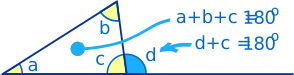
The interior angles of a triangle add to 180°:a + b + c = 180°Angles c and d make a straight angle (180°):d + c = 180°So d + c equals a + b + c:d + c = a + b + cSubtract c from both sides:d = a + b
Works For Any Triangle's Exterior Angle
Example:
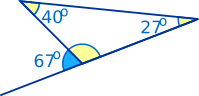
The exterior angle is 40° + 27° = 67°
And 67° > 40°
And 67° > 27°
Example: How big is angle d?
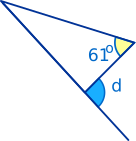
We can't calculate exactly, but we can say:
d° > 61°