Pythagoras' Theorem and Areas
Pythagoras' Theorem
Let's start with a quick refresher of the famous Pythagoras' Theorem.
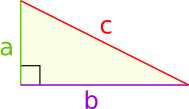
Pythagoras' Theorem says, in a right triangle:
the square of the hypotenuse (c) is equal to the sum of the squares of the other two sides (a and b).
a2 + b2 = c2
That means we can draw squares on each side:
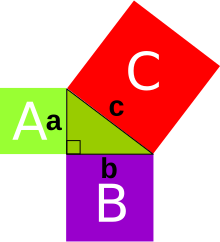
And this will be true:
A + B = C
You can learn more about the Pythagorean Theorem and review its algebraic proof.
A More Powerful Pythagorean Theorem
Say we want to draw semicircles on each side of a right triangle:
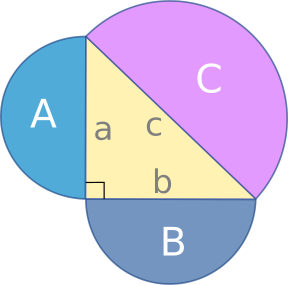
A, B and C are the areas of each
semicircle with diameters a, b and c.
Maybe A + B = C ?
But they aren't squares! Let's go ahead anyway to see where it leads us.
OK, the area of a circle with diameter "D" is:
Area of Circle = 14 π D2
So the area of a semicircle is half of that:
Area of Semicircle = 18 π D2
And so the area of each semicircle is:
A = 18 πa2
B = 18 πb2
C = 18 πc2
Now our question:
Does A + B = C ?
Let's substitute the values:
Does 18πa2 + 18πb2 = 18πc2 ?
We can factor out 18π and we get:
a2 + b2 = c2
Yes! It is simply Pythagoras' Theorem.
Therefore, we have shown that Pythagoras' Theorem is true for semicircles.
Will it work for any other shape?
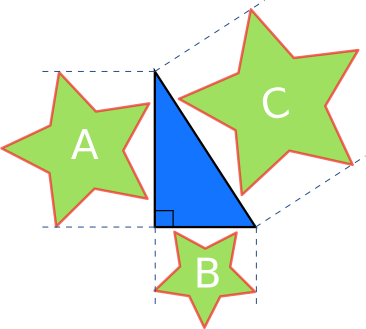
Yes! The Pythagorean Theorem can be taken further into a shape-generalized form as long as the shapes are similar: they must have the same proportions, you can't use a tall skinny triangle on one side and a short fat triangle on the other!
Shape-Generalized Form of the Pythagorean Theorem:
Given a right triangle, we can draw similar shapes on each side so that the area of the shape constructed on the hypotenuse is the sum of the areas of similar shapes constructed on the legs of the triangle.
A + B = C
Where:
- A and B are the areas of the shapes on the legs
- C is the area of the shape on the hypotenuse.
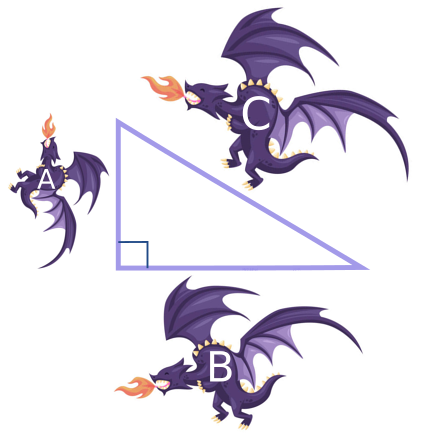
This also holds for cool shapes that aren't polygons, such as this amazing dragon!