Eccentricity
Eccentricity is how much a conic section (a circle, ellipse, parabola or hyperbola)
varies from being circular.
A circle has an eccentricity of zero, so the eccentricity shows us how "un-circular" the curve is. Bigger eccentricities are less circular.
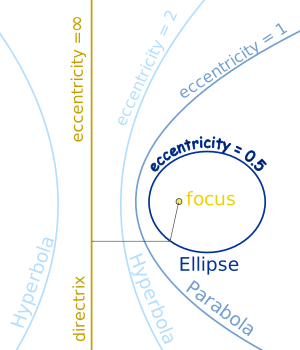
Different values of eccentricity make different curves:
- At eccentricity = 0 we get a circle
- for 0 < eccentricity < 1 we get an ellipse
- for eccentricity = 1 we get a parabola
- for eccentricity > 1 we get a hyperbola
- for infinite eccentricity we get a line
Eccentricity is often shown as the letter e (not to be confused with Euler's number "e", they are totally different)
In Space:
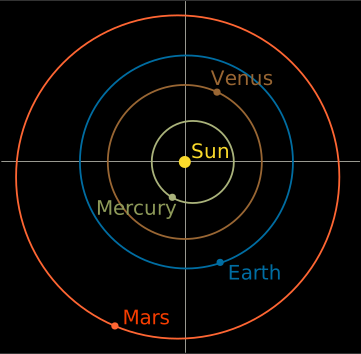
Most planets have nearly circular orbits with eccentricities close to 0
- Earth's orbit is nearly a circle with an eccentricity of about 0.017
- Halley's Comet has a very stretched orbit with an eccentricity of about 0.967, and only swings past the Sun every 75 years or so
- An object with an eccentricity greater than 1 will escape the system
Focus and Directrix

We can define eccentricity as the ratio of distances from any point P on the curve to a fixed point (the focus) and a fixed line (the directrix):
eccentricity e = distance from P to Focusdistance from P to Directrix
This ratio is the same for every point on the curve.
Animation
Try the slider to see what happens:
Calculating The Value
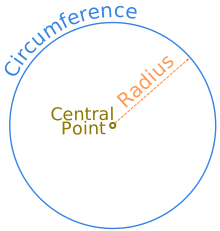 |
For a circle, eccentricity is 0 |
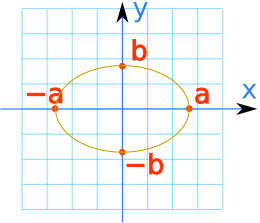 |
For an ellipse, eccentricity is: √a2 − b2a |
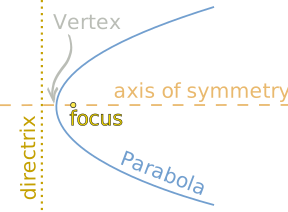 |
For a parabola, eccentricity is 1 |
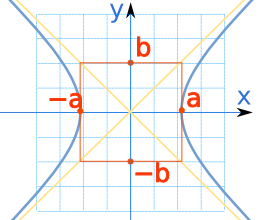 |
For a hyperbola, eccentricity is: √a2 + b2a |
Example for an ellipse: when a = 5 and b = 4, then
Example for a hyperbola: when a = 3 and b = 4, then
The distance from the center to a focus c is:
- Ellipse: c = √a2 − b2
- Hyperbola: c = √a2 + b2
So in both cases, eccentricity is simply: e = ca