Unit Vector
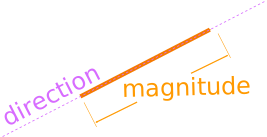
A vector has magnitude (its length) and direction:
Unit Vector
A Unit Vector has a magnitude of 1:
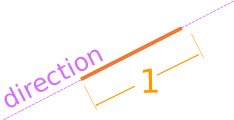
| Its symbol is usually a lowercase letter with a "hat", for example: |
 |
| (Pronounced "a-hat") |
Scaling
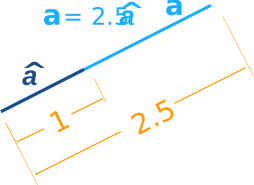
We can scale a unit vector by multiplying it by a number. Here, vector a is 2.5 times the unit vector. Notice it points in the same direction:
Finding a Unit Vector
To find a unit vector with the same direction as a given vector, we divide that vector by its magnitude (length):
- v = unit vector along v
- v = the vector
- |v| = magnitude of v
Example: find the unit vector along v = (3, 4)
Magnitude |v| = √(32 + 42) = √(9 + 16) = √25 = 5
Now divide each component by 5:
v = (35, 45) = (0.6, 0.8)
Check: its magnitude is √(0.62 + 0.82) = √(0.36 + 0.64) = √1 = 1. It works!
In 2 Dimensions
Unit vectors can be used in 2 dimensions:
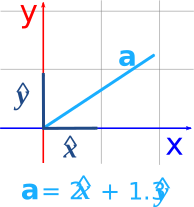
Here we show that the vector a is made up of 2 "x" unit vectors and 1.3 "y" unit vectors.
In this case we often use i and j like this:
- i (for the x-axis)
- j (for the y-axis)
So the vector a = 2i + 1.3j
Any Direction
In 3 Dimensions
We can also use unit vectors in three (or more!) dimensions:
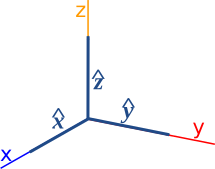
For 3D we can use i (x-axis), j (y-axis) and k (z-axis).