Open Sentences
An example of an open sentence: x + 3 = 6
First ... what's a "Sentence" ?
Just like an English sentence, a mathematical sentence says something:
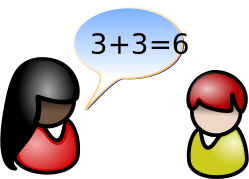
English:
- The sun is shining.
- Hawaii is in the Pacific Ocean.
Mathematics:
- 3 + 3 = 6
- 10 is an even number
Now ... what's a "Closed Sentence" or an "Open Sentence" ?
| Closed | A closed sentence is always true (or always false). |
| Open | An open sentence is not yet known to be true or false. |
Examples:
| 8 is an even number | is closed (it is always true) | |
| 9 is an even number | is closed (it is always false) | |
| n is an even number | is open (could be true or false, depending on the value of n) |
In that last example:
- if n is 4, the sentence is true
- if n is 5, the sentence is false
- and so on ...
But we didn't say what value n has!
So "n is an even number" may be true or false. So it is open.
Open Sentence
So, we get this definition:
An open sentence can be either true or false depending on what values are used.
Variables
The value we don't know is called a variable (sometimes called an unknown)
In this open sentence, x is a variable:
x + 3 = 8
In this one, w and q are both variables:
w + q = 2
Testing a Value (Evaluate)
To evaluate an open sentence, we try a value for the variable and see if the sentence becomes true or false.
Example: Is x + 3 = 8 true when x = 4?
Substitute (replace) x with 4:
4 + 3 = 8 ?
7 isn't equal to 8, so it is false. So x = 4 doesn't work.
Example: Is x + 3 = 8 true when x = 5?
5 + 3 = 8 ?
That's true, so x = 5 works.
Solving
Solving means finding a value for the variable that makes the sentence true.
Example: Solve x + 3 = 8
Let's subtract 3 from both sides:
x + 3 − 3 = 8 − 3
x = 5
Check: 5 + 3 = 8 is true
So we have solved x + 3 = 8 by making x = 5
Example: Solve x − 4 = 9
Add 4 to both sides:
x = 13
Check: 13 − 4 = 9 (true)
Example: Solve 3x = 18
Divide both sides by 3:
x = 6
Check: 3 × 6 = 18 (true)
Example: Solve x ÷ 2 = 5
Multiply both sides by 2:
x = 10
Check: 10 ÷ 2 = 5 (true)
Some More Examples
Here are some more examples of closed and open sentences:
Closed Sentences:
| A square has four corners | always true | |
| 6 is less than 5 | always false | |
| −3 is a negative number | always true |
Open Sentences:
| A triangle has n sides | Can be true or false (depends on the value of n) | |
| z is a positive number | Can be true or false (depends on the value of z) | |
| 3y = 4x + 2 | Can be true or false (depends on the values of x and y) | |
| a + b = c + d | Can be true or false (depends on the values of a,b,c,d) |