Complex Plane
 |
No, not that complex plane ... |
| ... this complex plane: |
a plane for complex numbers! |
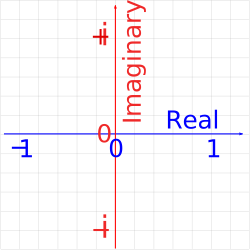
Real and Imaginary make Complex
A Complex Number is a combination of a Real Number and an Imaginary Number:
A Real Number is the type of number we use every day.
Examples: 12.38, ½, 0, −2000
When we square a Real Number we get a positive (or zero) result:
22 = 2 × 2 = 4
12 = 1 × 1 = 1
02 = 0 × 0 = 0
What can we square to get −1?
?2 = −1
Squaring −1 doesn't work because multiplying negatives gives a positive: (−1) × (−1) = +1, and no other Real Number works either.
So it seems mathematics is incomplete ...
... but we can fill the gap by imagining there's a number that, when multiplied by itself, gives −1
(call it i for imaginary):
i2 = −1
 .
.And together:
A Complex Number is a combination of a Real Number and an Imaginary Number
Examples: 3.6 + 4i, −0.02 + 1.2i, 25 − 0.3i, 0 + 2i
Putting a Complex Number on a Plane
You may be familiar with the number line:

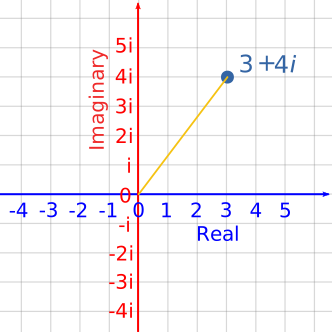
But where do we put a complex number like 3+4i ?
Let's have the real number line go left-right as usual, and have the imaginary number line go up-and-down:
|
We can then plot a complex number like 3 + 4i :
|
 |
|
|
And here's 4 − 2i :
|
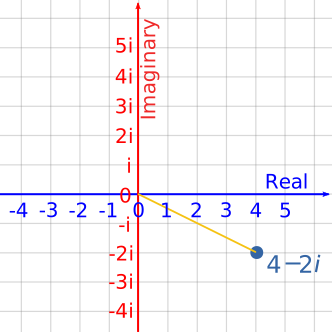 |
And that's the complex plane:
- complex because it is a combination of real and imaginary,
- plane because it is like a geometric plane (2 dimensional)
Whole New World
Now let's bring the idea of a plane (as seen in Cartesian coordinates, Polar coordinates, Vectors and so on) to complex numbers.
It will open up a whole new world of numbers that are more complete and elegant, as we'll see.
Complex Number as a Vector
We can think of a complex number as a vector.
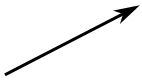
This is a vector.
It has magnitude (length) and direction.
| And here's the complex number 3 + 4i as a vector: |
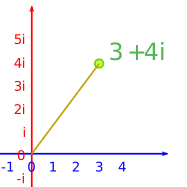 |
Adding
We can add complex numbers as vectors, too:
|
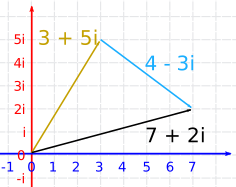
To add the complex numbers 3 + 5i and 4 − 3i :
separately, like this: (3 + 5i) + (4 − 3i) =(3 + 4) + (5 − 3)i
7 + 2i
|
 |
Polar Form
| Let's use 3 + 4i again: | |
|
|
Here it is in polar form: |
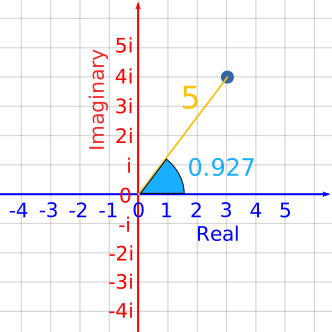 |
So the complex number 3 + 4i can also be shown as distance (5) and angle (0.927 radians).
Those two values (distance and angle) have special names:
- Modulus (r): The distance from the origin to the point. For 3 + 4i, the modulus is 5.
- Argument (θ): The angle measured counterclockwise from the positive Real axis. For 3 + 4i, the argument is 0.927 radians (or about 53.1°)
Let's see how to convert from one form to the other using Cartesian to Polar conversion:
Example: the number 3 + 4i
From 3 + 4i :
- Modulus (r) = √(x2 + y2) = √(32 + 42) = √25 = 5
- Argument (θ) = tan-1 (y/x) = tan-1 (4/3) = 0.927 (to 3 decimals)
And we get distance (5) and angle (0.927 radians)
Back again:
- x = r × cos( θ ) = 5 × cos( 0.927 ) = 5 × 0.6002... = 3 (close enough)
- y = r × sin( θ ) = 5 × sin( 0.927 ) = 5 × 0.7998... = 4 (close enough)
And distance 5 and angle 0.927 radians becomes 3 and 4 again.
In fact a common way to write a complex number in Polar form is
And "cos θ + i sin θ" is often shortened to "cis θ", so:
x + iy = r cis θ
cis is just shorthand for cos θ + i sin θ
3 + 4i = 5 cis 0.927
In some subjects, like electronics, "cis" is used a lot!
Distance
The distance between two complex numbers, z1 and z2, is the straight-line distance between their points on the complex plane.
To find the distance, we simply calculate the modulus of their difference:
Why it works: when we subtract z2 from z1, we get a new complex number that is the horizontal and vertical gaps between them. Taking the modulus gives us the straight-line distance.
Find the distance between z1 = 2 + 3i and z2 = 5 − i:
Find the difference:
Calculate the modulus:
Midpoint
The midpoint between two complex numbers is the exact center point between them. To find it, we simply calculate the average of the two numbers:
Why it works: Adding the two complex numbers and dividing by 2 automatically averages their Real parts (horizontal axis) and Imaginary parts (vertical axis) at the same time.
Find the midpoint between z1 = 2 + 3i and z2 = 5 − i:
Add the numbers together:
Divide by 2:
7 + 2i2 = 3.5 + i
Summary
- The complex plane is a plane with:
- real numbers running left-right and
- imaginary numbers running up-down
- To convert from Cartesian to Polar Form:
- r = √(x2 + y2)
- θ = tan-1 ( y / x )
- To convert from Polar to Cartesian Form:
- x = r × cos( θ )
- y = r × sin( θ )
- Polar form r cos θ + i r sin θ is often shortened to r cis θ
Next ... learn about Complex Number Multiplication.