Force Calculations

Force is push or pull.
Forces on an object are usually balanced
When forces are unbalanced the object accelerates:
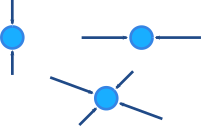
No Acceleration
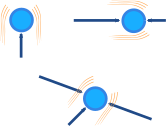
Acceleration
Example: The forces at the top of this bridge tower are in balance (it isn't accelerating):

The cables pull downwards equally left and right, and that's balanced by the tower's upwards push. (Does the tower push? Yes! Imagine you stand there instead of the tower.)
We can model the forces like this:
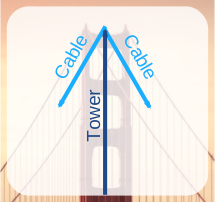
And when we put them head-to-tail we see they close back on themselves, meaning the net effect is zero:

The forces are in balance.
Forces in balance are said to be in equilibrium: there's also no change in motion.
Free Body Diagrams
The first step is to draw a Free Body Diagram (also called a Force Diagram)
In the bridge example the free body diagram for the top of the tower is:
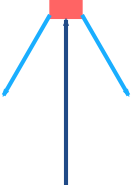
Free Body Diagram
It helps us to think clearly about the forces acting on the body.
Example: Car on a Highway
What are the forces on a car cruising down the highway?
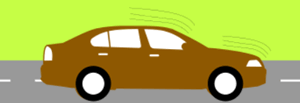
The engine is working hard, so why doesn't the car continue to accelerate?
Because the driving force is balanced by:
- Air resistance (put simply: the air resists being pushed around),
- Rolling resistance, also called rolling friction (the tires resist having their shape changed)
Like this:
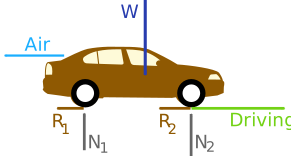
Free Body Diagram
W is the car's weight,
R1 and R2 are the rolling resistance of the tires,
N1 and N2 are the reaction forces (balancing out the car's weight).
Note: steel wheels (like on trains) have less rolling resistance, but are way too slippery on the road!
Weight or Mass?
- Mass is how much "stuff" (matter) is in an object. It is measured in kilograms (kg) and stays the same anywhere in the universe
- Weight is the force of gravity pulling down on that mass. It is measured in Newtons (N) and changes depending on gravity (you weigh less on the Moon!)
Free Body Diagrams use forces, so we use the object's weight on the diagram.
Calculations
Force is a vector. A vector has magnitude (size) and direction:
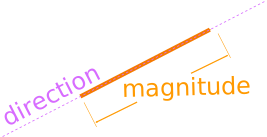
We can model the forces by drawing arrows of the correct size and direction. Like this:
Example: Admiring the View
Jade stands on the edge of a balcony supported by a horizontal beam and a strut:
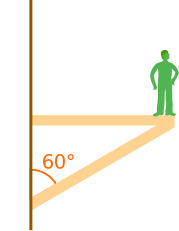
Jade weighs 80kg.
What are the forces?
Let's think about the forces at the end of the beam:
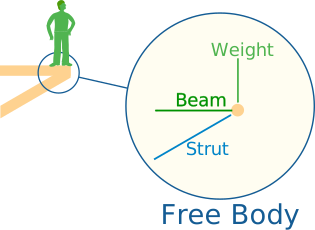
Weight
Jade's 80 kg mass creates a downward force due to Gravity.
Force is mass times acceleration: F = ma
The acceleration due to gravity on Earth is 9.81 m/s2, so a = 9.81 m/s2
F = 80 kg × 9.81 m/s2
F = 785 N
The Other Forces
The forces are balanced, so they should close back on themselves like this:
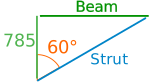
We can use trigonometry to solve it.
Because it is a right triangle, SOHCAHTOA will help.
For the Beam, we know the Adjacent, we want to know the Opposite, and "TOA" tells us to use Tangent:
tan(60°) = Beam/785 N
Beam/785 N = tan(60°)
Beam = tan(60°) × 785 N
Beam = 1.732... × 785 N = 1360 N
For the Strut, we know the Adjacent, we want to know the Hypotenuse, and "CAH" tells us to use Cosine:
cos(60°) = 785 N / Strut
Strut × cos(60°) = 785 N
Strut = 785 N / cos(60°)
Strut = 785 N / 0.5 = 1570 N
Solved:
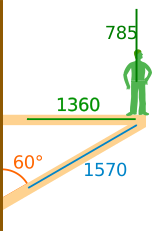
Interesting how much force is on the beam and strut compared to the weight being supported!
Torque (or Moment)
What if the beam is just stuck into the wall (called a cantilever)?
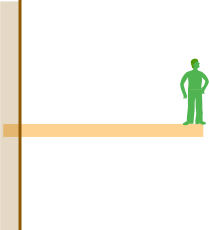
There's no supporting strut, so what happens to the forces?
The Free Body Diagram looks like this:
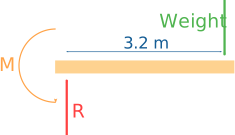
The upwards force R balances the downwards Weight.
With only those two forces the beam will spin like a propeller! But there's also a "turning effect" M called Moment (or Torque) that balances it out:
Moment: Force times the Distance at right angles.
We know the Weight is 785 N, and we also know the distance at right angles, which in this case is 3.2 m:
M = 785 N x 3.2 m = 2512 Nm
And that moment is what stops the beam from rotating.
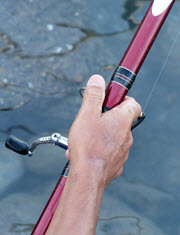
You can feel moment when holding onto a fishing rod.
As well as holding up its weight you have to stop it from rotating downwards.
Friction
Box on a Ramp
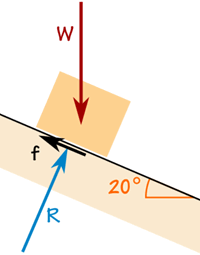
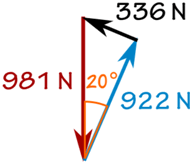
The box weighs 100 kg.
The friction force is enough to keep it where it is.
The reaction force R is at right angles to the ramp.
The box isn't accelerating, so the forces are in balance:
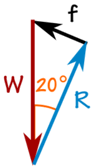
The 100 kg mass creates a downward force due to Gravity:
W = 100 kg × 9.81 m/s2 = 981 N
We can use SOHCAHTOA to solve the triangle.
Friction f:
sin(20°) = f/981 N
f = sin(20°) × 981 N = 336 N
Reaction N:
cos(20°) = R/981 N
R = cos(20°) × 981 N = 922 N
And we get:
Tips for Drawing Free Body Diagrams
- Draw as simply as possible. A box is often good enough
- Forces point in the direction they act on the body
- straight arrows for forces
- curved arrows for moments
Sam and Alex Pull a Box
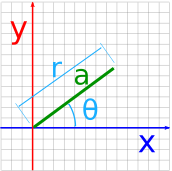
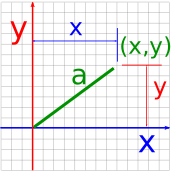
The calculations can sometimes be easier when we turn magnitude and direction into x and y:
 |
<=> |  |
| Vector a in Polar Coordinates |
Vector a in Cartesian Coordinates |
You can read how to convert them at Polar and Cartesian Coordinates, but here's a quick summary:
| From Polar Coordinates (r,θ) to Cartesian Coordinates (x,y) |
From Cartesian Coordinates (x,y) to Polar Coordinates (r,θ) |
|
|---|---|---|
|
|
Let's use them!
Example: Pulling a Box
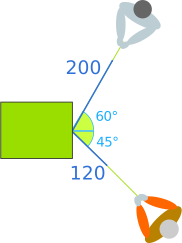
Sam and Alex are pulling a box (viewed from above):
- Sam pulls with 200 Newtons of force at 60°
- Alex pulls with 120 Newtons of force at 45° as shown
What's the combined force, and its direction?
Let's add the two vectors head to tail:
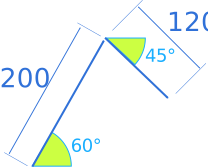
First convert from polar to Cartesian (to 2 decimals):
Sam's Vector:
- x = r × cos( θ ) = 200 × cos(60°) = 200 × 0.5 = 100
- y = r × sin( θ ) = 200 × sin(60°) = 200 × 0.8660 = 173.21
Alex's Vector:
- x = r × cos( θ ) = 120 × cos(−45°) = 120 × 0.7071 = 84.85
- y = r × sin( θ ) = 120 × sin(−45°) = 120 × -0.7071 = −84.85
Now we have:
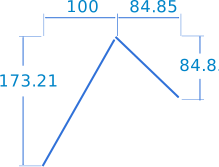
Add them:
(100, 173.21) + (84.85, −84.85) = (184.85, 88.36)
That answer is valid, but let's convert back to polar as the question was in polar:
- r = √ ( x2 + y2 ) = √ ( 184.852 + 88.362 ) = 204.88
- θ = tan-1 ( y / x ) = tan-1 ( 88.36 / 184.85 ) = 25.5°
And we have this (rounded) result:
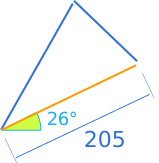
And it looks like this for Sam and Alex:
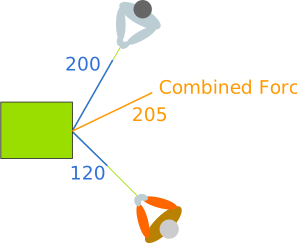
They might get a better result if they were shoulder-to-shoulder!
Elevator
And here's an example using Newton's Second Law:
- F is Force
- m is mass
- a is acceleration
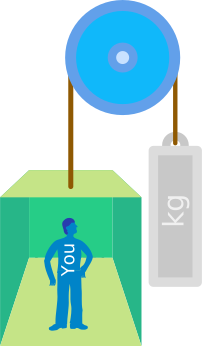
Example: Elevator Ride
You are in a free-running elevator held up by a weight on a pulley.
- You and the elevator together weigh 150kg
- The weight is 125kg
Are you in danger? What will your acceleration be?
Let's start with F = ma
We want to know acceleration so let's rearrange that into:
a = Fm
The total mass that's being accelerated is 150 kg + 125 kg = 275 kg
The force, though, is created only by the difference between weights:
Weight difference = 150 kg − 125 kg = 25 kg
With gravity (g=9.8 m/s2) that makes a force of:
Force = 25 kg × 9.8 m/s2 = 245 N
Let's plug our values in!
a = Fm = 245 N275 kg = 0.89 m/s2
So less than a tenth of gravity's acceleration, just don't fall too far!
(What if the weight was 160 kg?, or 200 kg?)