Counting to 1,000 and Beyond
1 to 20
one
two
three
four
five
six
seven
eight
nine
ten
eleven
twelve
thirteen
fourteen
fifteen
sixteen
seventeen
eighteen
nineteen
twenty
21 to 99
Join these:
twenty
thirty
forty
fifty
sixty
seventy
eighty
ninety
to these:
-one
-two
-three
-four
-five
-six
-seven
-eight
-nine
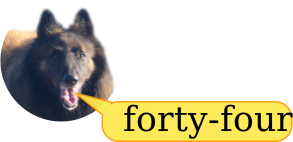
Note that forty doesn't have a u,
but four does!
Examples:
| 53 | fifty-three | |
| 60 | sixty | |
| 72 | seventy-two | |
| 99 | ninety-nine |
100 to 999
Write how many hundreds ("one hundred", "two hundred", and so on), then the rest of the number as above.
In UK English use "hundred and".
Examples:
| US | UK | |||
| 101 | one hundred one | one hundred and one | ||
| 116 | one hundred sixteen | one hundred and sixteen | ||
| 144 | one hundred forty-four | one hundred and forty-four | ||
| 212 | two hundred twelve | two hundred and twelve | ||
| 271 | two hundred seventy-one | two hundred and seventy-one | ||
| 621 | six hundred twenty-one | six hundred and twenty-one | ||
| 999 | nine hundred ninety-nine | nine hundred and ninety-nine |

1,000 to 999,999
For larger numbers we group the digits into sets of three. This makes them much easier to read!
Write how many thousands ("one thousand", "two thousand", and so on), then the rest of the number as above.
Examples:
| US | UK | |||
| 1,101 | one thousand, one hundred one | one thousand, one hundred and one | ||
| 15,016 | fifteen thousand, sixteen | fifteen thousand, and sixteen | ||
| (No hundreds? Don't write them! but the and is still needed in the UK) |
||||
| 112,621 | one hundred twelve thousand, six hundred twenty-one | one hundred and twelve thousand, six hundred and twenty-one | ||
| 999,999 | nine hundred ninety-nine thousand, nine hundred ninety-nine | nine hundred and ninety-nine thousand, nine hundred and ninety-nine | ||
Millions and More
Tip: Read in Groups of Three
A handy way is to split the digits into groups of three from the right:
191,232,891 = 191 | 232 | 891
Then we read each group (like a number from 0 to 999) and add the group name:
- 191 million
- 232 thousand
- 891
Put it together: one hundred ninety-one million, two hundred thirty-two thousand, eight hundred ninety-one.
Examples:
| US | UK | |||
| 1,006,101 | one million, six thousand, one hundred one | one million, six thousand, one hundred and one | ||
| 191,232,891 | one hundred ninety-one million, two hundred thirty-two thousand, eight hundred ninety-one | one hundred and ninety-one million, two hundred and thirty-two thousand, eight hundred and ninety-one | ||
| 999,999,999 | nine hundred ninety-nine million, nine hundred ninety-nine thousand, nine hundred ninety-nine | nine hundred and ninety-nine million, nine hundred and ninety-nine thousand, nine hundred and ninety-nine |
What About Zeros?
If a whole group is 000, we usually skip that group.
Examples:
| 7,020,000 | seven million, twenty thousand | |
| 5,000,042 | five million, forty-two | |
| 3,040,020 | three million, forty thousand, twenty |
(We don't say "zero thousand". We just leave that part out.)
Beyond Millions...
Use the same method for:
| Billion | 1,000,000,000 |
| Trillion | 1,000,000,000,000 |
| Quadrillion | 1,000,000,000,000,000 |
| Quintillion | and so on ... |
| Sextillion | |
| Septillion | |
| Octillion | |
| Nonillion | |
| Decillion | |
| Undecillion | |
| Duodecillion | |
| Tredecillion | |
| Quattuordecillion | |
| Quindecillion | |
| Sexdecillion | |
| Septemdecillion | |
| Octodecillion | |
| Novemdecillion | |
| Vigintillion | 1 followed by 63 zeros! |
Commas or Spaces
When writing the number put commas every three digits like this:
1,006,101
In Science it is common to use small spaces instead of commas:
1 006 101
When writing words some people use commas, some don't:
- one million, six thousand, one hundred one
- one million six thousand one hundred one
Which do you prefer?