Heron's Formula
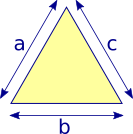
Area of a Triangle from Sides
We can calculate the area of a triangle if we know the lengths of all three sides, using a formula that has been known for nearly 2000 years.
It is called "Heron's Formula" after Hero of Alexandria (see below)
We use this two step process:
Step 1: Calculate "s" (half of the triangle's perimeter, called the semiperimeter):
s = a+b+c2
Step 2: Then calculate the Area:
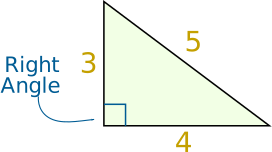
Example: What's the area of a triangle with sides 3, 4, and 5?
We already know its area is 3 × 42 = 6
But let's use Heron's formula:
Step 1: s = 3 + 4 + 52 = 122 = 6
Step 2: A = √6(6−3)(6−4)(6−5) = √6 × 3 × 2 × 1 = √36 = 6
It works perfectly!
Example: What's the area of a triangle where every side is 5 long?
Step 1: s = 5 + 5 + 52 = 7.5
Step 2: A = √(7.5 × 2.5 × 2.5 × 2.5) = √(117.1875) = 10.825...
Don't forget the final square root at the end!
Try it yourself:
Sanity Check
Does your triangle make sense? Make sure the three side lengths are able to make a real triangle.
The sides must satisfy the triangle inequality theorem:
a + b > c
a + c > b
b + c > a
If not, there's no triangle, the area isn't defined, and the formula won't work.
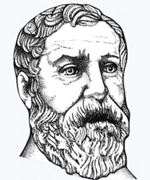
Hero of Alexandria
The formula is credited to Hero (or Heron) of Alexandria, who was a Greek Engineer and Mathematician in 10 – 70 AD.

Amongst other things, he developed the Aeolipile, the first known steam engine, but it was treated as a toy!
Angles
In the calculator above I also used the Law of Cosines to calculate the angles (for a complete solution). The formula is:
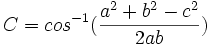
Where "C" is the angle opposite side "c".
But we don't need the angles to use Heron's Formula.