Intersecting Chords Theorem
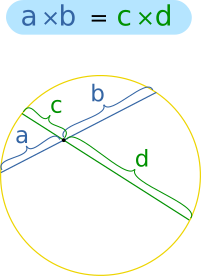
This is the idea (a, b, c and d are lengths):
And here it is with some actual values (measured only to whole numbers):
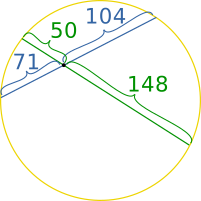
And we get
- 71 × 104 = 7384
- 50 × 148 = 7400
Very close! If we measured perfectly the results would be equal.
Why not try drawing one yourself?
Measure the lengths and see what you get.
Arcs and Angles
The same intersecting lines also create a relationship between the angles and the arcs they open up to:

θ = arc a + arc b2
The angle equals the average of the two arcs.
When the intersection point is on the circle (a tangent and a chord), it is like one of the arcs has shrunk to zero!

θ = arc a2
In this case the angle equals half the intercepted arc
Why is this all true?
Because there are similar triangles! Looking below:
- The angles θ are the same (see vertically opposite angles)
- The angles φ are the same (see inscribed angles)
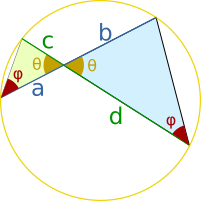
The triangles may not be the same size, but they have the same angles ... so all lengths will be in proportion!
One triangle has the ratio a/c, and the other has the matching ratio d/b:
a/c = d/b
a × b = c × d