Inflection Points
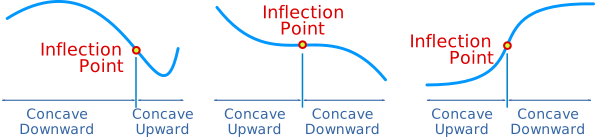
An Inflection Point is where a curve changes from Concave upward to Concave downward (or vice versa)
So what's concave upward / downward ?
| Concave upward is when the slope increases: | 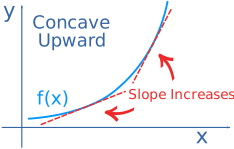 |
|
| Concave downward is when the slope decreases: | 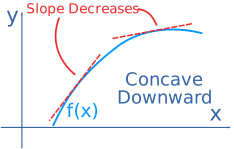 |
Here are some more examples:
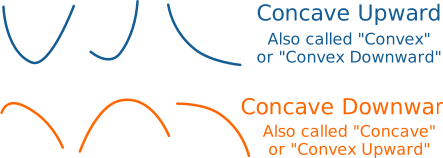
Learn more at Concave upward and Concave downward.
Finding where ...
So our task is to find where a curve goes from concave upward to concave downward (or vice versa).
Calculus
Derivatives help us!
The derivative of a function gives the slope.
The second derivative tells us if the slope increases or decreases.
- When the second derivative is positive, the function is concave upward
- When the second derivative is negative, the function is concave downward
And the inflection point is where it goes from concave upward to concave downward (or vice versa).
Example: y = 5x3 + 2x2 − 3x
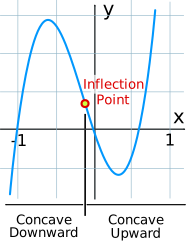
Let's work out the second derivative:
- The derivative is y' = 15x2 + 4x − 3
- The second derivative is y'' = 30x + 4
And 30x + 4 is negative up to x = −4/30 = −2/15, positive from there onwards. So:
And the inflection point is at x = −2/15
We can put that x-value in the equation above to find y ≈ 0.424 so we get:
Inflection point is (−2/15, 0.424...)
A Quick Refresher on Derivatives
In the previous example we took this:
y = 5x3 + 2x2 − 3x
and came up with this derivative:
y' = 15x2 + 4x − 3
There are rules you can follow to find derivatives. We used the "Power Rule":
- x3 has a slope of 3x2, so 5x3 has a slope of 5(3x2) = 15x2
- x2 has a slope of 2x, so 2x2 has a slope of 2(2x) = 4x
- The slope of the line 3x is 3
Another example for you:
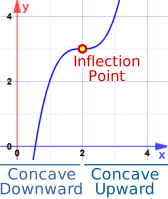
Example: y = x3 − 6x2 + 12x − 5
The derivative is: y' = 3x2 − 12x + 12
The second derivative is: y'' = 6x − 12
And 6x − 12 is negative up to x = 2, positive from there onwards. So:
And the inflection point is at x = 2:
Calculating the y value gets us inflection point = (2,3)
A second derivative of zero doesn't mean it must be an inflection point.
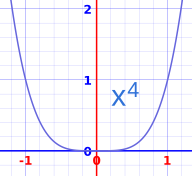
An inflection point's curve has to switch from concave up to concave down, or from concave down to concave up.
Example: for y = x4, the second derivative is 12x2. At x=0, the second derivative is 0, but it is concave upward on both sides, so there's no inflection point!