Standard Form
What is "Standard Form"?
that depends on what you are dealing with!
I have gathered some common "Standard Form"s here for you..
Note: Standard Form is not the "correct form", just a handy agreed-upon style. You may find some other form to be more useful.
Standard Form of a Decimal Number
In Britain this is another name for Scientific Notation, where you write down a number this way:
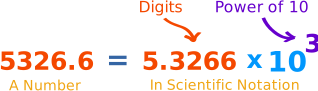
In this example, 5326.6 is written as 5.3266 × 10³,
because 5326.6 = 5.3266 × 1000 = 5.3266 × 10³
In other countries it means "not in expanded form" (see Composing and Decomposing Numbers):
| 561 | 500 + 60 + 1 |
| Standard Form | Expanded Form |
Standard Form of an Equation
The "Standard Form" of an equation is:
(some expression) = 0
In other words, we move all the terms to one side so that the other side is just 0.
Example: Put x2 = 7 into Standard Form
Subtract 7 from both sides so we get:
x2 − 7 = 0
Standard Form of a Polynomial
The "Standard Form" for writing down a polynomial is to put the terms with the highest degree first (like the "2" in x2 if there is one variable).
Example: Put this in Standard Form:
3x2 − 7 + 4x3 + x6
The highest degree is 6, so that goes first, then 3, 2 and then the constant last:
x6 + 4x3 + 3x2 − 7
When there is more than one variable, the degree of a term is the sum of all variable's exponents in that term.
Also, within each term, it is nice to have the variables in alphabetical order (if it does not make things more confusing):
Example: Put this in Standard Form:
5z2x + 2yx3
The highest degree is 4 (since 2yx3 has degree 1+3=4), so that term should go first, also put the variables in alphabetical order:
2x3y + 5xz2
Standard Form of a Linear Equation
The "Standard Form" for writing down a Linear Equation is
Ax + By = C
A shouldn't be negative, A and B shouldn't both be zero, and A, B and C should be integers.
Example: Put this in Standard Form:
y = 3x + 2
Bring 3x left:
−3x + y = 2
Multiply all by −1:
3x − y = −2
Note: A = 3, B = −1, C = −2
This form:
Ax + By + C = 0
is sometimes called "Standard Form", but is more properly called the "General Form".
Standard Form of a Quadratic Equation
The "Standard Form" for writing down a Quadratic Equation is

(a not equal to zero)
Example: Put this in Standard Form:
x(x−1) = 3
Expand "x(x−1)":
x2 − x = 3
Bring 3 to left:
x2 − x − 3 = 0
Note: a = 1, b = −1, c = −3
Standard Form of a Circle Equation
With a circle like this:
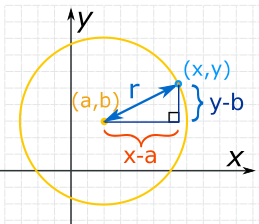
The Standard Form is this:
(x−a)2 + (y−b)2 = r2
See Circle Equations for more details.