Rational Expressions
An expression that's the ratio of two polynomials:
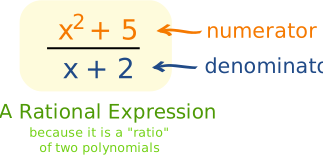
It is just like a fraction, but with polynomials.
Other Examples:
Also
| 12 − x2 | The top polynomial is "1" which is fine. |
| 2x2 + 3 | Yes it is! As it could also be written: 2x2 + 31 |
But Not
 |
2 − √(x)4 − x | the top isn't a polynomial (a square root of a variable isn't allowed) |
|
1 − x1 − 1/x |
1/x isn't allowed in a polynomial |
In General
A rational expression is the ratio of two polynomials P(x) and Q(x) like this
P(x)Q(x)
Except that Q(x) can't be zero (and anywhere that Q(x)=0 is undefined)
Finding Roots of Rational Expressions
|
A root (or zero) is where the expression equals zero: |
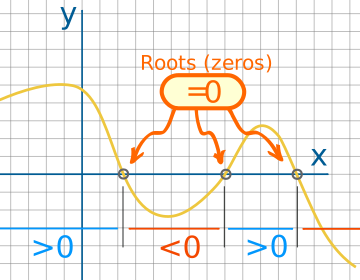 |
To find where a rational expression equals 0:
- First, find the x-values that make the denominator equal to zero. These values are not allowed, as Q(x) can't be zero (the expression is undefined there)
- Next, simplify the expression by canceling common factors, if possible
- Then, find the x-values that make the numerator of the simplified expression equal to zero. Any solutions that are not forbidden are the roots
Important: If a factor cancels, that x-value does not give a root. Instead, the graph usually has a hole there (example later).
Common Factors (Lowest Terms)
A fraction can have common factors (and so isn't in lowest terms).
Example: Fractions
26 is not in lowest terms,
as 2 and 6 have the common factor "2"
But:
13 is in lowest terms,
as 1 and 3 have no common factors
The same idea applies to rational expressions.
Example: Rational Expressions
x3 + 3x22x is not in lowest terms,
as the top and bottom have the common factor x
After canceling the common factor x:
x2 + 3x2 is in lowest terms
Once the expression is simplified, we find the x-values that make the numerator equal to zero. Any solutions that are not forbidden are the roots.
To learn how to find these x-values, see Solving Polynomials.
Example: Canceling Can Remove a Zero
x − 1x − 1
It looks like it simplifies to 1, but we must remember the denominator can't be zero.
- Original denominator: x−1=0 when x=1, so x=1 isn't allowed
- After canceling, the simplified form is 1, which is never 0, so there are no roots
So the graph is the line y=1 with a hole at x=1.
Hole vs. Asymptote
- If a factor cancels out completely from the bottom (like x − 1x − 1), it leaves a hole in the graph there
- If a factor stays in the bottom and can't be canceled, it creates a vertical asymptote (where the graph shoots off to infinity)
For the expression x − 2x − 5:
- What's the root? x = 2 is the root because it makes the numerator 0
- What value of x is not allowed? x = 5 isn't allowed because it makes the denominator 0
Proper vs Improper
| Fractions can be proper or improper: |
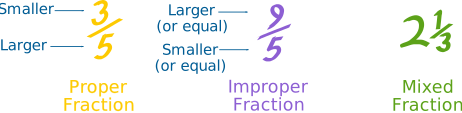 |
| (There's nothing wrong with "Improper", it is just a different type) |
And likewise:
A Rational Expression can also be proper or improper!
But what makes a polynomial larger or smaller?
The Degree !
For a polynomial with one variable, the Degree is the largest exponent of that variable.
Examples of Degree:
| 4x | The Degree is 1 (a variable without an exponent actually has an exponent of 1) |
|
| 4x3 − x + 3 | The Degree is 3 (largest exponent of x) |
So this is how to know if a rational expression is proper or improper:
Proper: the degree of the top is less than the degree of the bottom.
| Proper: | 1x + 1 | deg(top) < deg(bottom) |
Another Example: xx3 − 1
Improper: the degree of the top is greater than, or equal to, the degree of the bottom.
| Improper: | x2 − 1x + 1 | deg(top) ≥ deg(bottom) |
Another Example: 4x3 − 35x3 + 1
If the polynomial is improper, we can simplify it with Polynomial Long Division
Asymptotes
Rational expressions can have asymptotes (a line that a curve approaches as it heads toward infinity):
Example: (x2−3x)/(2x−2)
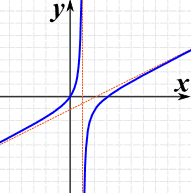
The graph of (x2−3x)/(2x−2) has:
- A vertical asymptote at x = 1
- An oblique asymptote: y = x2 − 1
A rational expression can have:
- any number of vertical asymptotes,
- only zero or one horizontal asymptote,
- only zero or one oblique (slanted) asymptote
Finding Horizontal or Oblique Asymptotes
It is fairly easy to find them ...
... but it depends on the degree of the top vs bottom polynomial.
The one with the larger degree will grow fastest.
Just like "Proper" and "Improper", but in fact there are four possible cases, shown below.
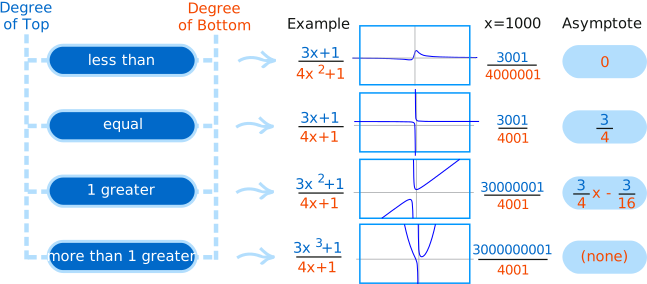
(I show a test value of x=1000 for each case, just to show what happens)
Let's look at each of those examples in turn:
For Degree of Top Less Than Bottom
The bottom polynomial will dominate, and there's a Horizontal Asymptote at zero.
Example: f(x) = (3x+1)/(4x2+1)
When x is 1000:
f(1000) = 3001/4000001 = 0.00075...
And as x gets larger, f(x) gets closer to 0
For Degree of Top Equal To Bottom
Neither dominates ... the asymptote is set by the leading terms of each polynomial.
Example: f(x) = (3x+1)/(4x+1)
When x is 1000:
f(1000) = 3001/4001 = 0.750...
And as x gets larger, f(x) gets closer to 3/4
Why 3/4? Because "3" and "4" are the "leading coefficients" of each polynomial

The terms are in order from highest to lowest exponent
(Technically the 7 is a constant, but here it is easier to think of them all as coefficients.)
The method is easy:
Divide the leading coefficient of the top polynomial by the leading coefficient of the bottom polynomial.
Here's another example:
Example: f(x) = (8x3 + 2x2 − 5x + 1)/(2x3 + 15x + 2)
The degrees are equal (both have a degree of 3)
Just look at the leading coefficients of each polynomial:
- Top is 8 (from 8x3)
- Bottom is 2 (from 2x3)
So there's a Horizontal Asymptote at 8/2 = 4
For Degree of Top Exactly 1 Greater Than Bottom
This is a special case: there's an oblique asymptote, and we need to find the equation of the line.
To work it out use polynomial long division: divide the top by the bottom to find the quotient (ignore the remainder).
Example: f(x) = (3x2+1)/(4x+1)
The degree of the top is 2, and the degree of the bottom is 1, so there will be an oblique asymptote
We need to divide 3x2+1 by 4x+1 using polynomial long division:
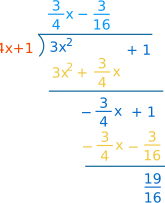
Ignoring the remainder we get the solution (from the top of the long division):
For Degree of Top More Than 1 Greater Than Bottom
When the top polynomial is more than 1 degree higher than the bottom polynomial, there's no horizontal or oblique asymptote.
Example: f(x) = (3x3+1)/(4x+1)
The degree of the top is 3, and the degree of the bottom is 1.
The top is more than 1 degree higher than the bottom so there's no horizontal or oblique asymptote.
Finding Vertical Asymptotes
There's another type of asymptote, which is caused by the bottom polynomial only.
But First: make sure the rational expression is in lowest terms!
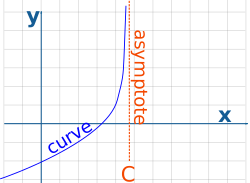
Whenever the simplified bottom polynomial is equal to zero (any of its roots) we get a vertical asymptote.
Read Solving polynomials to learn how to find the roots
From our example above:
Example: (x2−3x)/(2x−2)
The bottom polynomial is 2x−2, which factors into:
2(x−1)
And the factor (x−1) means there's a vertical asymptote at x=1 (because 1−1=0)
A Full Example
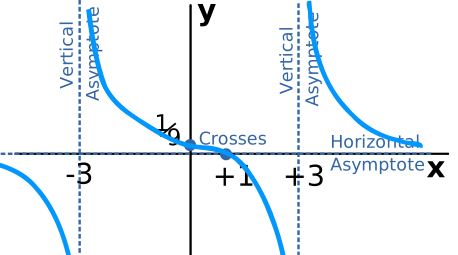
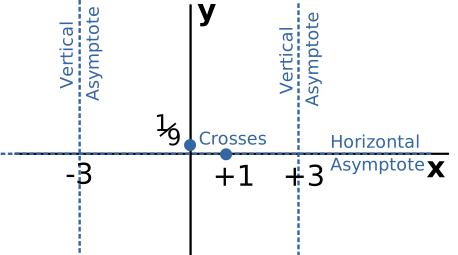
Example: Sketch (x−1)/(x2−9)
First of all, we can factor the bottom polynomial (it is the difference of two squares):
x−1(x+3)(x−3)
Now we can see:
The roots of the top polynomial are: +1 (this is where it crosses the x-axis)
The roots of the bottom polynomial are: −3 and +3 (these are Vertical Asymptotes)
It crosses the y-axis when x=0, so let's set x to 0:
Crosses y-axis at: 0−1(0+3)(0−3) = −1−9 = 19
We also know that the degree of the top is less than the degree of the bottom, so there's a Horizontal Asymptote at 0
So we can sketch all of that information:
And now we can sketch in the curve: