Polynomials: Sums and Products of Roots
Roots of a Polynomial
A "root" (or "zero") is where the polynomial is equal to zero:
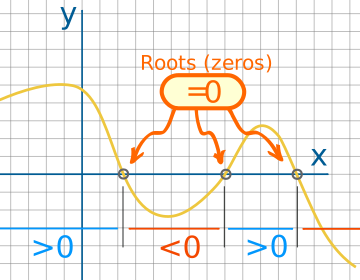
Put simply: a root is the x-value where the y-value equals zero.
General Polynomial
If we have a general polynomial like this:
f(x) = axn + bxn-1 + cxn-2 + ... + z
Then:
- Adding the roots gives −b/a
- Multiplying the roots gives (where "z" is the constant at the end):
- z/a (for even degree polynomials like quadratics)
- −z/a (for odd degree polynomials like cubics)
It works on Linear, Quadratic, Cubic and Higher!
It can sometimes help us solve things.
How does this magic work? Let's discover ...
Factors
We can take a polynomial, such as:
f(x) = axn + bxn-1 + cxn-2 + ... + z
And then factor it like this:
f(x) = a(x−p)(x−q)(x−r)...
Then p, q, r, and so on are the roots (where the polynomial equals zero)
Quadratic
Let's try this with a Quadratic (where the variable's biggest exponent is 2):
ax2 + bx + c
When the roots are p and q, the same quadratic becomes:
a(x−p)(x−q)
Is there a relationship between a,b,c and p,q ?
Let's expand a(x−p)(x−q):
a(x−p)(x−q)
= a( x2 − px − qx + pq )
= ax2 − a(p+q)x + apq
| Quadratic: | ax2 | +bx | +c |
| Expanded Factors: | ax2 | −a(p+q)x | +apq |
We can now see that −a(p+q)x = bx, so:
And apq = c, so:
And we get this result:
- Adding the roots gives −b/a
- Multiplying the roots gives c/a
This can help us answer questions.
Example: What's an equation whose roots are 5 + √2 and 5 − √2
The sum of the roots is (5 + √2) + (5 − √2) = 10
The product of the roots is (5 + √2) (5 − √2) = 25 − 2 = 23
And we want an equation like:
ax2 + bx + c = 0
When a=1 we can work out that:
- Sum of the roots = −b/a = -b
- Product of the roots = c/a = c
Which gives us this result
x2 − (sum of the roots)x + (product of the roots) = 0
The sum of the roots is 10, and product of the roots is 23, so we get:
x2 − 10x + 23 = 0
And here's the plot:
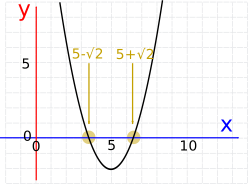
(Question: what happens if we choose a=−1 ?)
Cubic
Now let's look at a Cubic (one degree higher than Quadratic):
ax3 + bx2 + cx + d
As with the Quadratic, let's expand the factors:
a(x−p)(x−q)(x−r)
= ax3 − a(p+q+r)x2 + a(pq+pr+qr)x − a(pqr)
And we get:
| Cubic: | ax3 | +bx2 | +cx | +d |
| Expanded Factors: | ax3 | −a(p+q+r)x2 | +a(pq+pr+qr)x | −apqr |
We can now see that −a(p+q+r)x2 = bx2, so:
And −apqr = d, so:
This is interesting ... we get the same sort of thing:
- Adding the roots gives −b/a (exactly the same as the Quadratic)
- Multiplying the roots gives −d/a (similar to +c/a for the Quadratic)
(We also get pq+pr+qr = c/a, which can itself be useful.)
Higher Polynomials
The same pattern continues with higher polynomials.
In General:
- Adding the roots gives −b/a
- Multiplying the roots gives (where "z" is the constant at the end):
- z/a (for even degree polynomials like quadratics)
- −z/a (for odd degree polynomials like cubics)