Solving Rational Inequalities
Rational
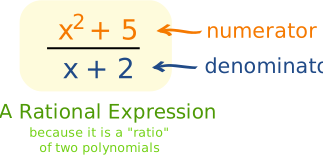
A Rational Expression looks like:
Inequalities
Sometimes we need to solve rational inequalities like these:
| Symbol | Words | Example |
|---|---|---|
| > | greater than | (x+1)/(3−x) > 2 |
| < | less than | x/(x+7) < −3 |
| ≥ | greater than or equal to | (x−1)/(5−x) ≥ 0 |
| ≤ | less than or equal to | (3−2x)/(x−1) ≤ 2 |
Solving
Solving inequalities is very like solving equations ... we do most of the same things.
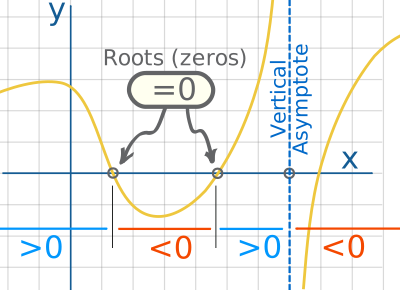 |
| When we solve inequalities we try to find interval(s), such as the ones marked "<0" or ">0" |
These are the steps:
- 1. Simplify the inequality so that one side is 0 (for example, f(x) > 0 or f(x) < 0)
- 2. Find "points of interest":
- the "=0" points (roots), and
- where the function is undefined (vertical asymptotes)
- 3. In between the "points of interest", the function is either greater than zero (>0) or less than zero (<0)
- choose a test value from each interval to see if it is >0 or <0
Here's an example:
Example: 3x−10x−4 > 2
First, let's simplify!
But We Can't Multiply By (x−4)
Instead, bring "2" left:
3x−10x−4 − 2 > 0
Then multiply the 2 by (x−4)/(x−4):
3x−10x−4 − 2x−4x−4 > 0
Now we have a common denominator, let's bring it all together:
3x−10 − 2(x−4)x−4 > 0
Simplify:
x−2x−4 > 0
Second, let's find "points of interest".
At x=2 we have: (0)/(x−4) > 0, which is a "=0" point, or root
At x=4 we have: (x−2)/(0) > 0, which is undefined
Third, do test points to see what it does in between:
At x=0:
- x−2 = −2, which is negative
- x−4 = −4, which is also negative
- So (x−2)/(x−4) must be positive
We can do the same for x=3 and x=5 (or any other values in those intervals), and end up with these results:
| x=0 | x=2 | x=3 | x=4 | x=5 | |
|---|---|---|---|---|---|
| x−2 | < 0 | > 0 | > 0 | ||
| x−4 | < 0 | < 0 | > 0 | ||
| (x−2)/(x−4) is | > 0 | 0 | < 0 | undefined | > 0 |
That gives us a complete picture!
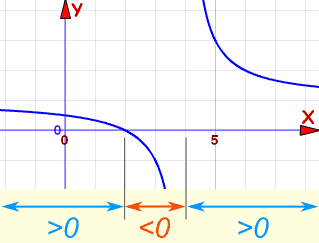
And where is it > 0 ?
- Less than 2
- Greater than 4
So, after rearranging and analysing 3x−10x−4 > 2 we get the result for x:
(−∞, 2) U (4, +∞)
We did all that without drawing a graph!
And here's that graph: