Axioms, Theorems, Corollaries, Lemmas
What are all those things? They sound so impressive!
Well, they are basically just facts: statements that have been proven to be true (or accepted as true).
- An Axiom (or Postulate) is a starting rule we accept as true without proof
- A Theorem is a major result (proved using axioms and earlier results)
- A Corollary is a result that follows directly from a theorem
- A Lemma is a result proved mainly to help prove another theorem
- A Conjecture is an idea we think is true but haven't proven yet. Once a conjecture is proven, it becomes a theorem!
Note: A result is called a lemma because of how it is used, not because it is small.
Examples
Example: An Axiom
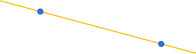
Axiom: In basic geometry: through any two points there's exactly one straight line.
This isn't proved, it is a starting rule we agree to use.
All proofs are built on axioms: without them there would be nowhere to start.
Example: A Theorem and a Corollary
Theorem:
Angles on one side of a straight line always add to 180°.
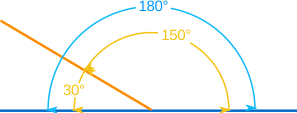
Corollary:
From this theorem we can show that when two lines intersect, the angles opposite each other (called Vertical Angles) are equal.
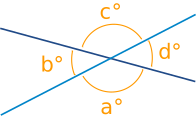
Angle a = angle c
Angle b = angle d
Proof:
Angles a and b lie on a straight line, so:
a + b = 180°
a = 180° − b
Likewise for angles b and c:
b + c = 180°
c = 180° − b
Since both a and c equal 180° − b, we have:
a = c
And a slightly more complicated example from Geometry:
Example: A Theorem with Corollaries
Theorem:
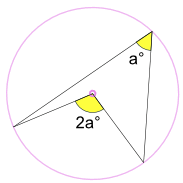
An inscribed angle a° is half of the central angle 2a°
Called the Angle at the Center Theorem.
Proof:
Join the center O to A.
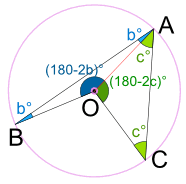
Triangle ABO is isosceles (two equal sides, two equal angles), so:
And, using Angles of a Triangle add to 180°:
Triangle ACO is also isosceles, so:
Using Angles of a Triangle add to 180°:
Using Angles around a point add to 360°:
Since b + c = a, we get:
Angle BAC = a° and Angle BOC = 2a°
And so the theorem is proved.
Corollary
If the endpoints stay the same, then the inscribed angle is always the same, no matter where it is on the circle:
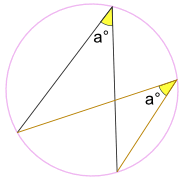
So, angles subtended by the same arc are equal.
Corollary (Special Case): Angle in a Semicircle
In the special case where the central angle forms a diameter of the circle:
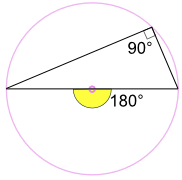
2a° = 180° , so a° = 90°
So an angle inscribed in a semicircle is always a right angle.
Another example, related to Pythagoras' Theorem:
Example: Pythagoras
Theorem
If m and n are any two whole numbers and
- a = m2 − n2
- b = 2mn
- c = m2 + n2
then
a2 + b2 = c2
Proof:
Corollary
a, b and c, as defined above, are a Pythagorean Triple
This follows directly from theorem.
Example (A Specific Case)
If m = 2 and n = 1, then
- a = 22 − 12 = 4 − 1 = 3
- b = 2 × 2 × 1 = 4
- c = 22 + 12 = 4 + 1 = 5
So 3, 4, and 5 form a Pythagorean triple.