Asymptote
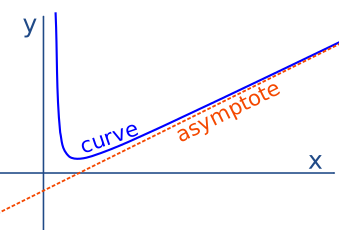
An asymptote is a line that a curve approaches, as it heads toward infinity:
Types
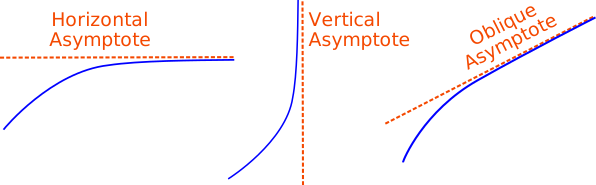
There are three types: horizontal, vertical and oblique:
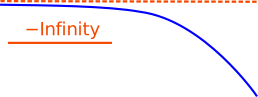
The direction can also be negative:
The curve can approach from either side (such as from above or below for a horizontal asymptote),
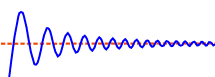
or may actually cross over (possibly many times), and even move away and back again.
The important point is that:
The distance between the curve and the asymptote tends to zero as they head to infinity (or −infinity)
Horizontal Asymptotes
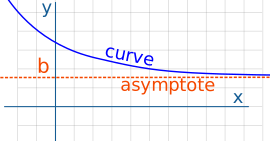
It is a horizontal asymptote when:
as x goes to infinity (or −infinity) the curve approaches some constant value b
Vertical Asymptotes
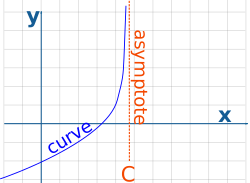
It is a vertical asymptote when:
as x approaches some constant value c (from the left or right) then the curve goes toward infinity (or −infinity).
Oblique Asymptotes
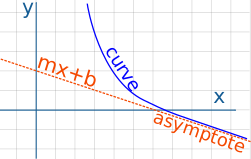
It is an oblique asymptote when:
as x goes to infinity (or −infinity) then the curve goes toward a line y=mx+b
(note: m isn't zero as that's a horizontal asymptote).
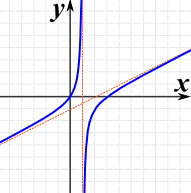
Example: (x2−3x)/(2x−2)
The graph of (x2−3x)/(2x−2) has:
- A vertical asymptote at x=1
- An oblique asymptote: y=x/2 − 1
Play with it here:
These questions will only make sense when you know Rational Expressions: